What's actually being shown
It's worth stating plainly what's on screen, because the framing matters. What appears in most explicit content isn't a representative sample of ordinary bodies. It's a heavily selected, often surgically altered, frequently edited presentation, filmed under lighting and angles chosen specifically to flatter. Treating it as a normal reference point for what bodies look like is a bit like judging ordinary architecture against a movie set.
The trouble is that repetition doesn't care whether something is representative. See a narrow band of body types often enough, and the mind starts treating that narrow band as the baseline, quietly, without any conscious decision being involved.
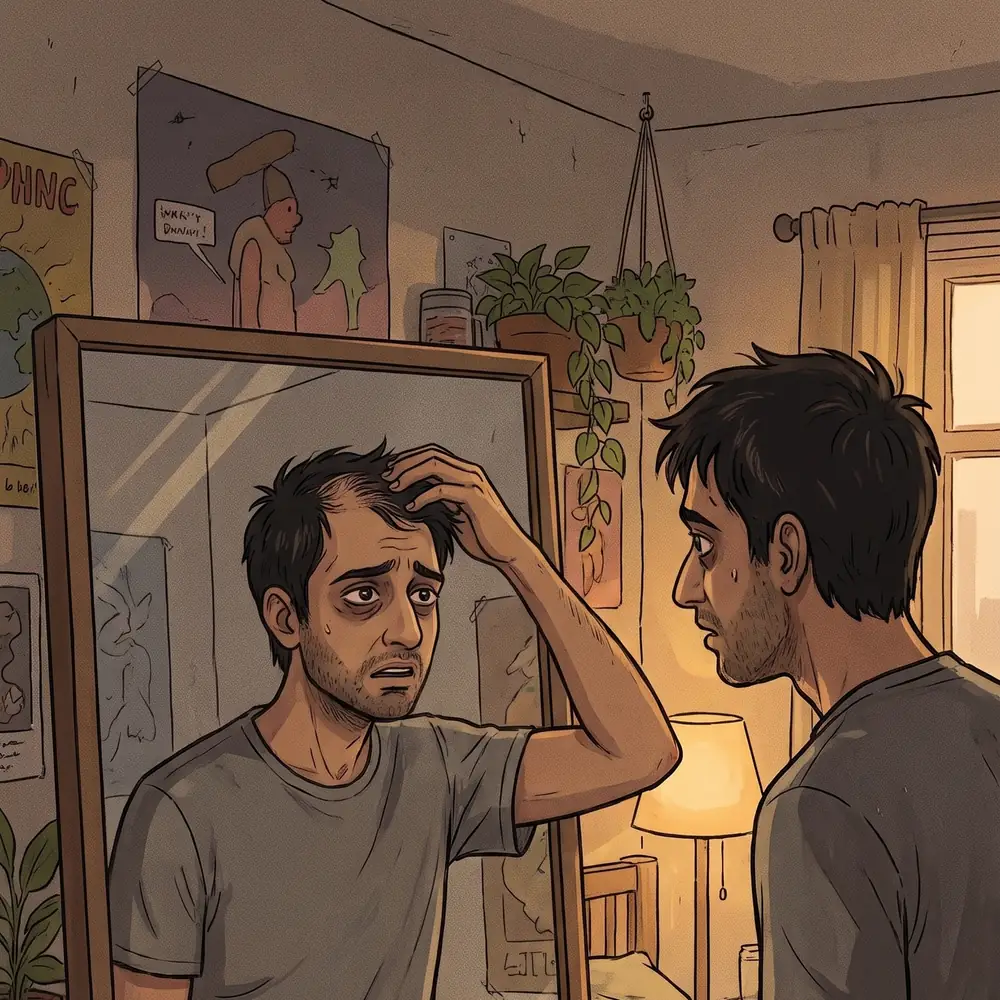
It cuts in two directions
Most discussion of this focuses on how it affects expectations of a partner, and that's real. Comparing a real partner's body against a curated, edited standard is a losing comparison for the real body every time, and it can quietly erode attraction and satisfaction in a relationship that has nothing wrong with it beyond the comparison itself.
The less-discussed direction is what it does to a person's view of their own body. Comparing yourself against performers selected specifically for a narrow appearance standard is a comparison built to make anyone feel inadequate by design. This shows up as real anxiety, sometimes severe, in people who never connect the feeling back to its actual source.
Worth sitting with: if body-related anxiety has grown alongside heavier use, even if the connection never occurred to you before, it is worth taking seriously as a possible cause rather than a coincidence. The two tend to move together more often than people expect.
A word on how this lands differently
Women often experience a compounded version of this, absorbing both the direct comparison to performers and the awareness that a partner may be holding the same unrealistic standard, sometimes without saying so. Our piece on women and porn covers this experience more fully; it deserves its own treatment rather than a footnote here.
What actually helps
- Name the mechanism specifically. Understanding that the standard is curated and unrepresentative, not simply "what bodies look like," takes real force out of the comparison the next time it shows up.
- Reduce the input, since the standard resets over time. The comparison loses its grip gradually as exposure decreases, since the mind's sense of "normal" recalibrates toward what it actually sees day to day rather than what it saw most intensely.
- Get real information, not performed information. Ordinary, unfiltered images of ordinary bodies, and honest conversations with people you trust, do more to correct a distorted baseline than willpower ever will on its own.
- If it's affecting a relationship, say so directly. A partner cannot address a comparison they don't know is happening. This connects to the broader case in what porn does to real intimacy.
Stop resetting the baseline
The standard only keeps distorting if the input keeps coming. Qlean closes explicit content the moment it appears on your phone, across every app, so the baseline gets a real chance to recalibrate.
Get Qlean on Google PlayWhy this deserves its own page
This effect rarely gets named directly, and that silence lets it operate unquestioned in a lot of people's minds for years. Naming it plainly, this is a manufactured, curated standard, not an accurate picture of real bodies, is a small act with a real effect, and it's worth doing deliberately rather than hoping the distortion quietly corrects itself.