The reward system, briefly
The brain has a well-studied reward circuit, built around dopamine, that evolved to reinforce behaviour genuinely useful for survival: eating, social bonding, sex itself. Dopamine is not "the pleasure chemical" exactly, a common oversimplification; it is more accurate to describe it as a signal that drives wanting and motivation, pushing you toward a reward rather than purely producing the enjoyment of it. This system is old, powerful, and shared across essentially all mammals.
Why novelty specifically matters so much
The reward system responds especially strongly to novelty, which is precisely what makes an endless stream of new content so effective at driving continued engagement. This is not unique to explicit content; it is the same mechanism behind the pull of an infinite social media feed, covered in social media's reward loop, and behind engineered game mechanics, covered in gaming and compulsive loops. The delivery mechanism, unlimited, always-new content on demand, is the specific thing engineered here, more than any property of the content itself.
What the evidence does not support: claims of permanent structural brain damage, a "fried" or irreversibly altered brain, or a fixed, precisely quantified percentage of grey matter lost. These claims circulate widely and are not supported by the current research. What the evidence does support is real, and does not need exaggeration to matter.
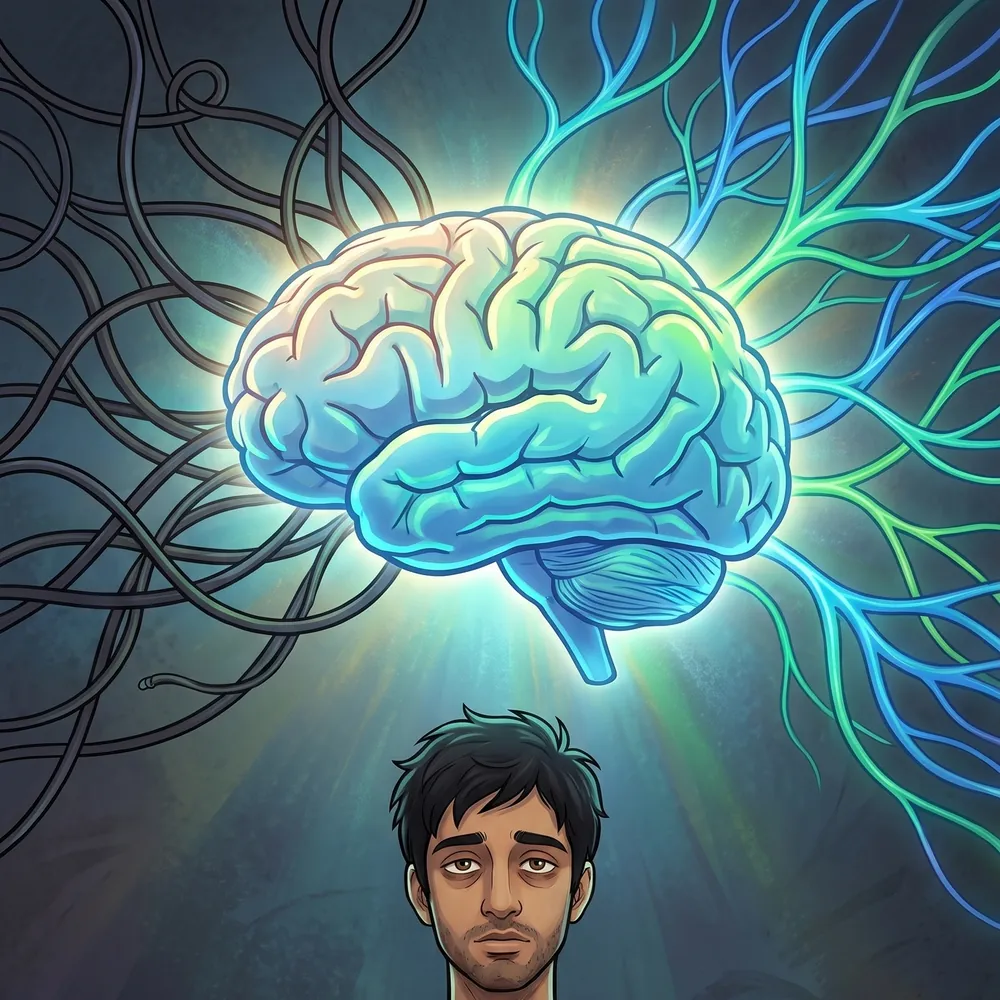
Tolerance and desensitization, the well-supported part
What is genuinely well documented is a pattern of tolerance: needing more novel, more intense, or more frequent stimulation to achieve the same level of engagement that milder content previously produced. This is not unique to this behaviour either; it is a general feature of how reward circuits respond to frequent, intense stimulation of any kind. It is also the mechanism behind why escalation is such a consistently reported pattern, covered in signs of porn addiction.
What this looks like in real life
- Reduced response to ordinary rewards. Everyday pleasures, a good meal, a conversation, a hobby, can start to feel flat by comparison, simply because they cannot compete with the intensity the reward system has become calibrated to.
- Difficulty with real intimacy. A pattern well documented enough to have its own dedicated research literature; see porn-induced ED recovery for the mechanism and the evidence specifically.
- A pull toward more extreme content over time. A direct consequence of tolerance, not a separate mystery.
The genuinely hopeful part
Reward-system sensitivity is not fixed. It recalibrates with reduced stimulation, which is the actual mechanism behind what people describe as a "dopamine reset." Our piece on how long a dopamine reset takes covers the realistic timeline for this recalibration, generally weeks to a few months rather than an instant fix, but a real and well-supported process, not wishful thinking.
Give the reward system a real chance to recalibrate
Recalibration needs the stimulation to actually stop, not just decrease. Qlean closes explicit content the moment it appears on your phone, across every app, so the process gets an uninterrupted run.
Get Qlean on Google PlayThe honest summary
This is not a story about a damaged, broken brain, and it is not nothing either. It is a normal, well-documented reward-circuit response to an unusually novel and intense stimulus delivered on demand, in a pattern that tends toward tolerance and escalation, and that recalibrates with time once the stimulation actually stops. That is a real reason to take this seriously, stated at the level the evidence actually supports.