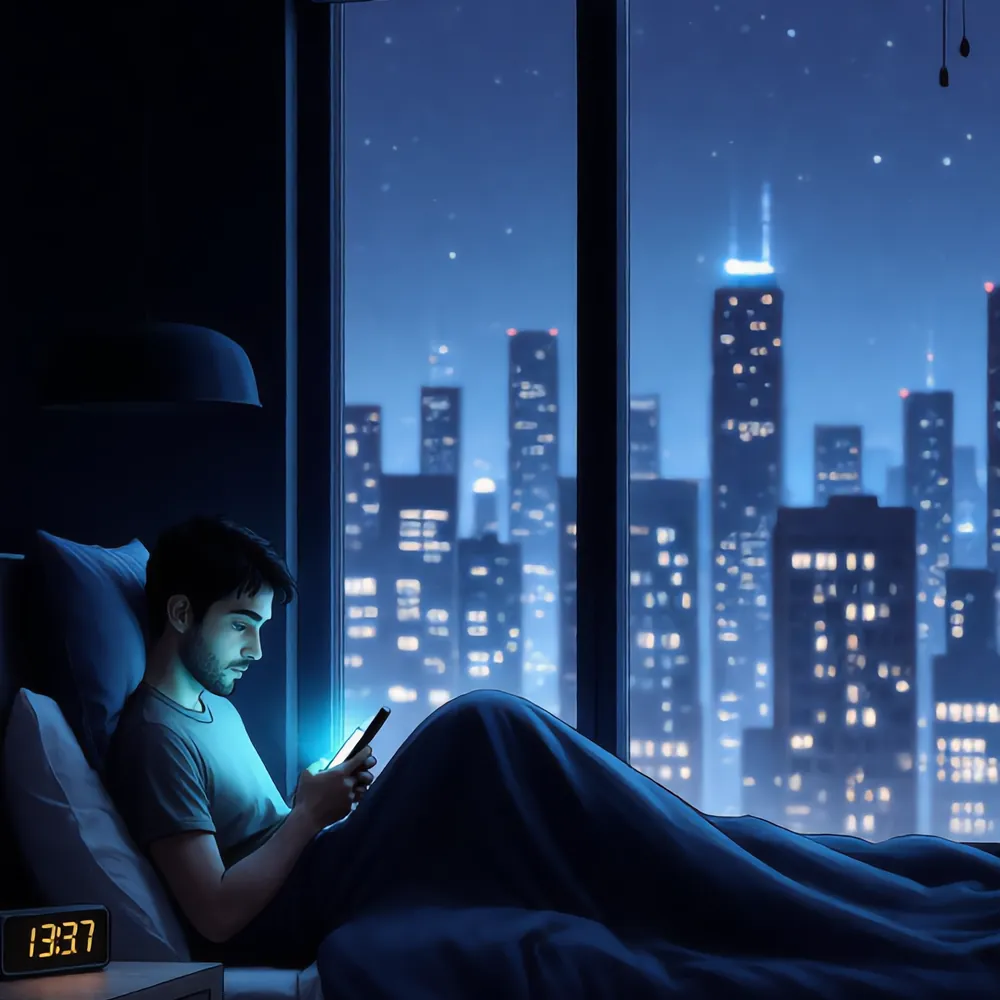
Why is bed the hardest place to stop scrolling?
Three things line up against you at once. You are tired, which makes decisions harder. You have no deadline, because nothing forces the evening to end except you. And the feed has no ending of its own, so nothing hands you a natural place to stop.
A fourth is quieter. Over time, the bed becomes a cue. If you scroll there most nights, the act of lying down starts to prompt the reach for the phone before you have decided anything, the same way a certain chair makes you want to open a laptop. The habit is attached to the place.
This is why willpower is such a poor plan for the late evening. It is a plan that depends on the one resource that is lowest at that hour. We make the same point about short video generally in how to stop doomscrolling on Android, and bed is where it applies most.
What does research say about screens and sleep?
It is easy to overstate this, so here is what one well-known study found and what it did not.
In 2015, Chang and colleagues published a controlled laboratory study in PNAS comparing the evening reading of a light-emitting e-reader with a printed book. Twelve adults took part. Compared with the printed book, the light-emitting device was linked to taking longer to fall asleep, lower evening levels of the sleep hormone melatonin, a delayed body clock, and lower alertness the next morning.
The limits matter as much as the finding. The sample was small, it was a laboratory protocol and not a study of ordinary life, and it was about light from a screen, not about what was on the screen. It does not show that your phone is damaging your sleep, and it says nothing about short video or news in particular. What it does is give a reasonable basis for treating the last stretch before sleep as worth protecting.
If you have persistent trouble sleeping, that is a reason to speak to a doctor, not to rely on a habit guide. Everything below is about the habit, which is the part a guide like this can help with.
What is a plan that actually works?
The plan has to work when you are tired and not trying. That means decisions made earlier and an environment that does the work. In order of effort:
- Pick a phone curfew and write it down. A specific time, such as thirty minutes before the time you want to be asleep. A vague intention to stop earlier is exactly what the feed beats.
- Charge the phone away from the bed. Across the room, on a shelf or in another room. The single biggest effect comes from making the reach take a few seconds instead of none.
- Use a real alarm clock. If the phone is your alarm, that is the stated reason it stays by the bed. A cheap alarm clock removes the reason.
- Make an if-then rule for the night. For example, "if I wake and want to check the time, I will look at the clock and turn over". Deciding in advance helps because you will not be able to decide well at the time.
- Put something else within reach. A paper book, or a notebook for the thought that keeps you up. The aim is to have an alternative to hand, because stopping with nothing to do is hard.
For the other end of the night, our guide to stopping the first-thing-in-the-morning check uses the same idea in reverse. Both are mostly about where the phone sleeps.
What does Android’s Bedtime mode do?
Android's Digital Wellbeing includes a Bedtime mode, which on some phones is called Wind Down. Its main options are turning the screen to greyscale and turning on Do Not Disturb, and it can start at set times or while the phone is charging. Names and menus differ between manufacturers, so look in Digital Wellbeing on your own phone.
It is worth using. Greyscale makes feeds less appealing, and silencing the phone removes the notifications that pull you back in. Do Not Disturb can still allow calls from starred contacts and repeat callers, which matters if someone needs to reach you in a real emergency.
Be honest about its limit, though. Greyscale reduces the appeal and does not remove the feed, and Bedtime mode can be switched off with a tap, which a tired person will do. It is a good supporting setting and a weak primary plan.
Where does closing the feed itself fit?
It fits as the layer that holds when everything else has slipped. If you are in bed, the phone is in your hand and you open Instagram or YouTube out of habit, a closed short-video feed means the habit finds nothing to feed on.
Qlean's Strict level closes Reels, Shorts and Spotlight and leaves the rest of each app usable. It closes them whatever the hour, so it is not a bedtime schedule, and we would not describe it as one. Standard closes adult content and leaves everything else alone.
Be clear about what it will not do. It does not stop you reading the news, and it does not stop you messaging people. If your late-evening problem is worry rather than video, closing the feed solves the smaller part, and the plan above matters more.
Remove the 11pm feed
On Strict, Qlean closes Reels, Shorts and Spotlight and leaves messages and search working. Standard closes adult content and leaves everything else alone.
Qlean is a distraction blocker for Android. It closes the so-called entertainment that eats your attention: time-consuming Reels and Shorts, endless feeds, adult content and porn, the moment they open on your phone. No willpower needed. It never records your screen and keeps no record of what you view.
Get Qlean on Google PlayWhat if you share a bed with someone who scrolls too?
It makes the habit harder to break, because each of you is a cue for the other, and it makes the conversation more useful than it first sounds. A rule you make together tends to hold better than one you impose on yourself, partly because someone else will notice when it slips.
Keep the request small and about the room, not about the person. "Could we both charge our phones in the hall for a month?" is easier to agree to than "you're on your phone too much". It also removes the awkward asymmetry in which one of you has changed and the other has not.
If your partner does not want to change, you can still do your half. Keeping your own phone out of reach changes your evening even if theirs is unchanged, and many people find that their partner follows once they see that it works.
What do you do instead of scrolling?
Stopping with nothing to replace the scroll is the part most plans forget. The first few nights, a quiet room and an empty hand can feel strange, and that gap is where the old habit comes back.
- A paper book on the bedside table. Dull on purpose. A book that is mildly interesting is better than one that is gripping, because you want to sleep and not to finish a chapter.
- A notebook for the thought that will not leave. Many late scrolls are an attempt to avoid a worry. Writing it down, with the next step, tells your head it has been handled.
- The same short routine each night. Teeth, lights, a few slow breaths. A routine is a cue too, and a better one to build than the phone.
- A plan for waking at night. If you wake and cannot sleep, get up briefly, in low light, and do something dull, instead of reaching for the screen. Lying there scrolling usually makes it worse.
None of this is exotic, and that is the point. The aim is to make the sleepy, low-effort path the one that does not involve a screen.
What if you scroll anyway?
You will, some nights. Treat it as information and not as failure. Ask what was different: were you stressed, was the phone within reach, did you skip the curfew? Usually there is a specific gap, and the fix is to close that one gap rather than to promise to try harder.
Resist the temptation to make the rule stricter in the morning, in a burst of resolve. Rules built at nine on a bright morning are the ones that fail at eleven at night. Make the change that would have helped last night and leave the others alone.
Give it two weeks before judging. The first few nights tend to feel odd, with the hand reaching for something that is not there, and that awkwardness is a reasonable sign the cue is weakening.