The difference between a habit and a compulsion
An ordinary habit responds, at least eventually, to a decision to change it. It might take real, sustained effort and a few failed attempts along the way, but a person doing something out of preference can usually cut back once they genuinely commit to trying. A compulsion behaves differently, and I think this difference is under-discussed. The person doing it often wants to stop, sincerely tries to stop, and finds that wanting isn't enough on its own, the behaviour keeps happening anyway, sometimes within hours of a genuinely sincere decision not to.
This distinction matters because people stuck in a compulsive pattern frequently blame themselves for a lack of willpower, when the more accurate description is that willpower alone was never going to be sufficient, in the same way it isn't sufficient for other compulsive or addictive patterns either. Recognising this isn't an excuse to stop trying. It's a correction to the strategy, because strategies built only around "try harder next time" tend to fail the same way, for the same underlying reasons, over and over, no matter how much genuine effort gets poured into them.
This piece is different from our broader guide on signs of porn addiction, which focuses on porn use specifically, and from our piece on whether porn addiction is real, which addresses the addiction framing head on. Here the focus is narrower and deliberately so: masturbation as a standalone compulsive pattern in its own right, whether or not porn happens to be involved at all.
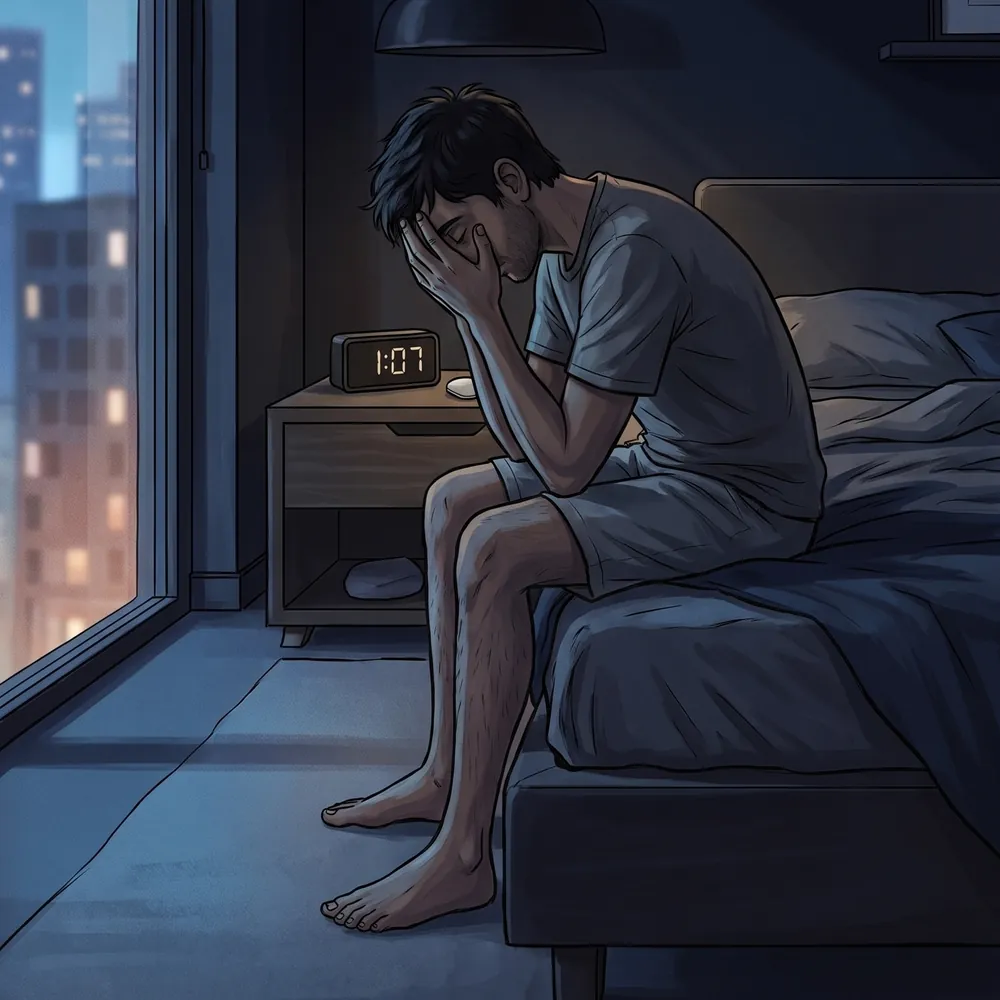
What compulsive sexual behaviour actually looks like
The pattern that clinicians and researchers describe under names like Compulsive Sexual Behaviour Disorder or out-of-control sexual behaviour typically includes several features appearing together, not just frequency taken on its own:
- Repeated, genuine attempts to significantly reduce the behaviour that keep failing despite real intent.
- Continuing the behaviour despite it causing real distress, or actively interfering with work, relationships, or health.
- The behaviour increasingly used to cope with stress, low mood, or anxiety, rather than for enjoyment in itself.
- A pattern that continues even after the actual enjoyment of it has visibly faded away.
- A sense that the behaviour is happening almost automatically, on a kind of autopilot, rather than as a conscious decision each time.
No single item on this list is, by itself, proof of a genuinely compulsive pattern. What tends to distinguish it is several of these showing up together, over a sustained stretch of time, not simply as an isolated rough week during a stressful month.
It's worth being honest about how the diagnostic conversation around this has shifted. Sexual behaviour that today gets described through a clinical, compulsion-focused lens was, for a long time, lumped together loosely under the word "addiction" without much precision, borrowed straight from how substance dependence gets described. The more recent Compulsive Sexual Behaviour Disorder framing is a deliberate, more careful move away from that borrowed language, because the underlying mechanism, while it shares real features with addiction, isn't identical to it. What matters practically for you isn't which exact label applies. It's recognising the actual shape of the pattern described above, and taking it seriously regardless of what it gets called.
A distinction worth sitting with: wanting to do something often is not the same as being unable to stop. The second is what actually defines a compulsion. The first, on its own, is just a strong preference, and strong preferences respond to ordinary willpower in a way compulsions simply don't.
Why frequency alone is the wrong measure
It's tempting to define "compulsive" by a number, some specific threshold of times per day or week past which it officially counts as a problem. That's not how the clinical picture actually works, and leaning on a frequency threshold misses people who masturbate less often but feel completely unable to stop when the urge actually hits, while wrongly flagging people who masturbate more often but experience it as a genuine, satisfying choice they're entirely comfortable with. The self-check questions from our piece on whether masturbation frequency is normal apply here directly: control, escalation, and how you feel afterward tell you more than any raw count ever will.
I'd also add that the felt experience of "automatic" is often more telling than anything else on the list. People describe reaching for the behaviour and only fully registering what they were doing partway through, or after it was already finished, as though some part of the decision-making process was skipped entirely. That specific sensation, more than any number, is usually what someone means when they say a pattern feels compulsive rather than simply frequent.
A related marker worth naming is what happens to the emotional payoff over time. In an ordinary habit, satisfaction stays roughly proportional to the behaviour, more or less the same reward each time, plainly enjoyed. In a compulsive pattern, people frequently describe the satisfaction thinning out considerably while the behaviour itself continues at the same rate or even increases, a widening gap between how much is happening and how little it's actually delivering. That gap, more than the raw frequency on either side of it, is often the clearest internal signal that something has shifted from preference into compulsion.
Why compulsive patterns resist "just cutting back"
Moderation asks someone in a compulsive pattern to make the same difficult decision over and over, at the exact moment they're least equipped to make it well, which is usually mid-urge, under real stress, or late at night with nobody around to see. Each attempt at moderation that fails doesn't just fail neutrally and get forgotten. It tends to reinforce the belief that the person can't be trusted with their own boundary, which makes the next attempt genuinely harder, not easier, building a kind of learned helplessness around the specific behaviour.
This is the practical argument for full retention specifically in the compulsive case, more so than in an ordinary habit case. A single, unconditional line removes the exact decision point that a compulsive pattern is best at winning, the in-the-moment negotiation about whether this one time counts, whether this particular time is somehow different, whether cutting back "close enough" is good enough just for today. There's no negotiation left to have when the answer was already decided in advance, in a clear moment, and doesn't depend at all on how the current moment happens to feel.
There's a psychological relief in this that surprises a lot of people once they actually try it. Constantly renegotiating a boundary is exhausting in a way that's easy to underestimate until it stops. Every moderation attempt keeps the subject mentally open, a live question revisited daily, which paradoxically keeps the compulsive pattern more present in someone's thinking than it would be under a closed, unconditional standard. Closing the question entirely, rather than reopening it every single day, tends to quiet the whole preoccupation faster than anyone expects going in.
Remove one decision point entirely
A compulsive pattern thrives on the moment of decision. Qlean closes explicit content the moment it appears on your phone, across every app, removing one of the most common entry points before the negotiation with yourself even has a chance to start.
Get Qlean on Google PlayBuilding structure around a compulsive pattern
Full retention as a stated goal is necessary but rarely sufficient on its own for a genuinely compulsive pattern, in a way it might actually be sufficient for a milder, ordinary habit. What tends to help alongside it, based on what I've seen work for people in this specific situation:
- Removing the moment of decision itself, not just the behaviour that follows it. Device-level blocking, real accountability, and structured time all work because they act before the urge has any real chance to argue its case, not during the argument itself, when it's already winning.
- Naming the coping function honestly. If the behaviour has quietly become a way to manage stress, loneliness, or anxiety, that underlying need doesn't simply disappear the moment the behaviour stops. It needs a genuine replacement, not just an absence with nothing filling the space it left behind.
- Getting support beyond willpower alone, whether that's a trusted person, a structured accountability program, or in more entrenched cases, an actual mental health professional. A pattern that meets several of the compulsive criteria above, especially ongoing distress and repeated genuine failed attempts to change it, is a reasonable, entirely non-shameful reason to bring in outside help, the same way any other stubborn behavioural pattern would warrant it.
- Giving the practice a durable framework, not just a rule. This is where traditions built around conserving sexual energy, rather than simply denying it, tend to offer more than a bare "don't" ever can. A discipline framed as building toward something, steadiness, clarity, self-command, gives a compulsive pattern something to lose ground to, rather than just a wall to keep bumping against. That reframe alone changes how sustainable the whole practice feels over months, not just days.
The point isn't to diagnose yourself, it's to stop blaming yourself
None of this is offered as a self-diagnosis checklist to work through anxiously. It's offered because a huge number of people in this exact situation quietly assume the problem is that they're weak, lazy, or uniquely undisciplined compared to everyone else managing this fine, when the more accurate and considerably more useful description is that they're dealing with a pattern that behaves differently from an ordinary habit and genuinely needs a strategy built for that difference. Full retention gives that strategy a clean, unconditional target to aim at. The structure built around it is what actually makes that target reachable in practice, not just in theory.
If you recognise yourself in several of the features described here, I'd encourage you to treat that recognition as useful information rather than as a verdict on your character. The strategy changes once you understand what you're actually dealing with. That alone is often the difference between another failed attempt at moderation and a genuinely different outcome this time.
Give yourself the same patience you'd extend to anyone else working through a genuinely difficult, deeply ingrained pattern. Progress here is rarely a straight line, and a setback inside a serious effort is a very different thing from the same setback inside a half-hearted one. The structure matters more than any single day does. Keep building it.